
A two-group espresso machine can be the wrong choice for one operation, while a well-matched one-group setup may suit another. The decision in a one group vs two group espresso machine comparison isn’t a ranking of quality. It’s about how the machine, staff, and counter work together when orders arrive at once. If you’re unsure whether one group can keep up during a rush, or concerned that extra capacity may sit idle, start by looking closely at your busiest service periods.
Group count affects how baristas share brewing tasks, but it doesn’t determine performance on its own. This guide compares one-group and two-group machines by workflow, peak demand, available space, and staffing needs. It also explains how to compare machine configurations and operating requirements. With a clear picture of your peak periods, menu, and working space, you can choose a setup that supports service without investing in capacity your team is unlikely to use.
Key Takeaways
- A group is a brewing station. Count the stations to understand how many espresso tasks can run in parallel.
- Use observed peak periods, not daily averages alone, to judge whether your workflow needs more brewing capacity.
- Compare one group vs two group espresso machine options by workflow, staffing, footprint, and intended use, not by assuming more groups mean better coffee.
- Map brewing alongside milk preparation and other drink tasks to see whether a second group would meaningfully ease service.
- Compare each machine’s configuration and operating requirements with the space and capacity your operation can use.
One-Group vs. Two-Group Espresso Machines: What Changes in Daily Service?
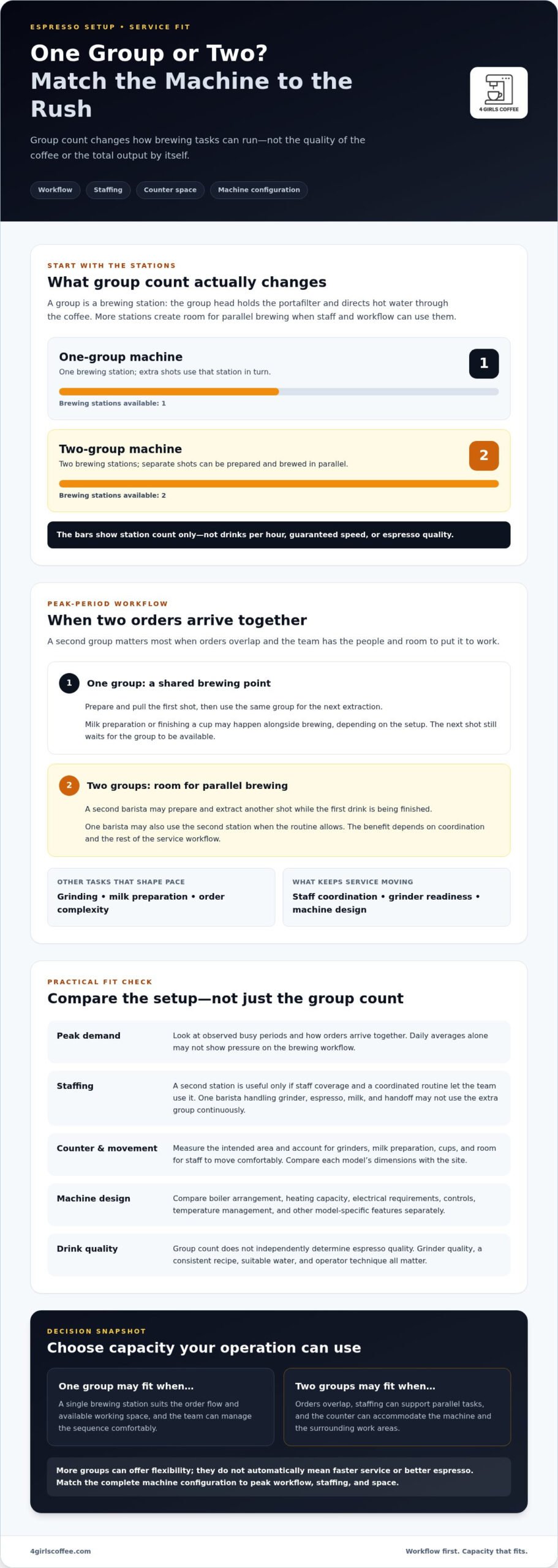
A group is an espresso-brewing station on a machine. The group head holds the portafilter and directs hot water through the coffee to produce an extraction. A one-group machine has one brewing station; a two-group machine has two. This affects how brewing tasks can be arranged, but doesn’t tell you by itself how many drinks the machine can produce overall.
In the one group vs two group espresso machine decision, group count describes the number of brewing points, not the full design of the machine. Boiler arrangement, heating capacity, electrical requirements, controls, and other model-specific features also affect how a machine performs. For a general background on espresso-machine types and development, see Espresso machine.
What does one group or two groups mean?
Each group head provides a place to brew espresso. With one group, baristas use that station for each extraction in turn. With two groups, separate portafilters can be prepared and brewing tasks can proceed in parallel, provided staff and workflow are organized to use both stations. That can give a team more flexibility when several espresso orders arrive together.
Consider a café receiving two espresso-drink orders at once. At a one-group machine, the barista brews one shot, then uses the group for the next. Another task, such as preparing milk, may happen alongside brewing, depending on the setup. With two groups, a second barista can prepare and pull another shot at the other station while the first barista continues their task. The advantage is parallel workflow, not a guaranteed number of drinks per hour.
Group count alone doesn’t establish total output. Order complexity, staff coordination, grinder readiness, and the machine’s design all affect how smoothly service moves. A second group is useful only when the operation can put it to work.
Does a two-group machine automatically make better espresso?
No. Group count doesn’t independently determine espresso quality. A well-prepared shot depends on several elements working together: grinder quality, a consistent recipe, suitable water, and the operator’s technique. Adding another group creates an additional brewing station; it doesn’t automatically improve the coffee in the cup.
Machines with different group counts may also differ in boiler design, power, temperature management, and controls. Assess those characteristics separately rather than inferring them from the number of groups. A one-group machine can support careful, consistent preparation, while a two-group machine can offer more room for simultaneous brewing. Compare complete machine configurations with the demands of your service, not group count as a proxy for quality.
How Group Count Shapes Espresso Workflow, Staffing, and Space
Group count changes how brewing work can be arranged during a rush. A one-group setup creates a focused sequence around a single brewing station: prepare the coffee at the grinder, dose and tamp, pull the shot, then move on to the next extraction. A barista can often prepare milk or finish a cup between brewing steps, but overlapping espresso orders still rely on that one station.
With two groups, a second brewing task can proceed while another drink is being finished. That flexibility matters most when orders overlap and the team has enough people and space to use it. More groups don’t automatically mean faster service. Grinding, milk preparation, order complexity, and staff coordination can remain the limiting steps.
How do the configurations affect peak-period workflow?
Picture two milk-based drinks arriving together. A barista grinds and prepares the first dose, starts its extraction, then steams milk while the espresso brews. At a one-group machine, the next shot must wait for the group to be available, which can add pressure when another order comes in.
At a two-group machine, a second barista may prepare and extract the next shot while the first drink is being finished. One barista may also use the second station when the workflow allows. Either way, parallel brewing can help the team manage overlapping tasks, but it doesn’t guarantee a fixed output rate. The benefit depends on the full service routine.
How do staffing and counter space change the decision?
Capacity is useful only when staffing can support it. If one barista is managing the grinder, espresso, milk, and handoff, a second group may offer flexibility without being used continuously. With enough barista coverage and a coordinated routine, two stations can make it easier to divide tasks during busy periods.
Give space the same practical attention. Measure the intended counter area and account for the machine alongside grinders, milk preparation, cups, and the room staff need to move comfortably. A compact model may suit a constrained counter, while a larger setup may need more working space. Dimensions vary by machine, so compare each model’s measurements and operating requirements with the site before deciding.
To compare configurations in context, browse one-group and two-group espresso machines and consider how each could fit your counter, staffing, and peak workflow.
One-Group vs. Two-Group Espresso Machine: A Practical Comparison
The best fit depends on how orders arrive, who is available to prepare them, and how much counter space the machine can occupy. This comparison can help make the one group vs two group espresso machine decision more practical. Keep in mind that model specifications and the broader setup matter as much as group count.
| Consideration | One-group machine | Two-group machine |
|---|---|---|
| Workflow | One brewing station supports a focused sequence of espresso tasks. | Two brewing stations can support concurrent extractions when the workflow calls for them. |
| Space | Worth considering when the counter footprint is limited; check the specific model’s measurements. | May require more counter and working room, though actual dimensions vary by model. |
| Staffing fit | Can suit a streamlined workflow with one barista managing brewing and other drink tasks. | Can be useful when staffing allows tasks to be divided or brewing to happen in parallel. |
| Likely use case | Lower-volume service or a more predictable flow where a single group can meet the workflow. | Regular overlapping orders where additional brewing capacity can be put to use. |
When is a one-group machine a sensible fit?
A one-group machine is worth considering for a smaller operation, a lower or more predictable order flow, or a counter where working space is limited. It can also suit a team with limited barista coverage, since adding a second group won’t necessarily ease service if there isn’t someone available to use it. 4 Girls Coffee offers one-group options, including compact models such as the 1 Group EX3 High Group Compact Coffee Machine and the 1 Group Ruggero Classic Compact Coffee Machine.
When does a two-group machine make more sense?
A two-group machine may better suit regular peak periods when orders overlap and a second brewing station supports the team’s routine. That advantage is most relevant when staff can divide preparation and finishing tasks, and the counter layout leaves room for the machine, grinders, cups, and movement. 4 Girls Coffee offers two-group options, including the 2 Group MegaCrem Coffee Machine and the 2 Group Ruggero Classic Compact Coffee Machine.
Before comparing specific machines, review their dimensions and technical requirements, then consider how those details fit the site and daily workflow. Don’t assume a compact two-group model and a one-group machine occupy the same space or have identical requirements. Neither configuration is universally superior. The right choice is the one whose capacity, footprint, and specifications align with the way your operation serves guests.
How to Decide Between One and Two Groups for Your Operation
A sound choice starts with the service you actually run, not an idealized forecast. Use this four-step process to assess the one group vs two group espresso machine decision against demand, workflow, space, and model requirements.
- Estimate demand from real service patterns. Record a typical shift and your busiest periods, noting when espresso orders overlap. Daily averages can hide short stretches when the bar is under pressure, so pay particular attention to those peaks. Avoid relying on a universal drinks-per-hour threshold. The right capacity depends on your menu, team, and service rhythm.
- Map the workflow. Trace orders through grinding, espresso preparation, milk steaming, payment, and handoff. Note which tasks can happen at the same time and where staff or equipment must wait. A menu with frequent milk-based drinks may create different demands from one centered on simpler espresso orders.
- Review staffing and space. Consider who is available during peak periods and whether another group could be used effectively. Measure the counter area and account for grinder placement, milk preparation, cups, and staff movement, not just the machine’s footprint. Allow for realistic growth, but don’t buy capacity based only on a speculative future rush.
- Compare complete machine configurations. Review model-specific dimensions and electrical, water, and operating requirements in the product information. Group count is only one part of the decision; the machine must suit the space and the way your team works.
This process helps distinguish brewing pressure from other bottlenecks. If orders wait because one barista is handling several tasks, an additional group may not resolve the constraint on its own. If overlapping espresso preparation is a recurring challenge and staffing can support parallel work, a second group may better match the service pattern.
For a broader view of equipment considerations, use the commercial espresso machine checklist. Then compare product information for the machines on your shortlist with your operational needs.
Ready to compare options against your workflow? Explore espresso machine choices and focus on configurations that fit your service, counter, and team.
Choose a Group Count That Fits Your Workflow, Not Just Your Ambition
The right group count is the one your operation can use well. For the one group vs two group espresso machine decision, weigh your busiest service periods, available barista coverage, and working space together. A two-group machine offers room for parallel brewing, but that capacity is valuable only if orders overlap regularly and staff can put both stations to work.
A concise decision rule for your shortlist
Use these points to narrow the options, then assess each machine on its own specifications:
- Start with one group if service is modest, work is usually sequential, or counter space is constrained.
- Evaluate two groups if orders regularly overlap and your staffing and routine can make parallel brewing useful.
These are starting points, not fixed rules. A busy period may reveal pressure that daily averages conceal, while a larger machine may add little value if another part of the workflow is the actual bottleneck.
What to compare before choosing a specific machine
Compare more than the number of groups. Review the machine’s footprint alongside grinder placement, milk preparation, cup storage, and the space staff need to move comfortably. Then examine product-specific details such as boiler design and operating requirements. Machines with the same group count can differ in configuration, so avoid assuming they’ll perform alike.
Grinder compatibility matters, too. The grinder and espresso machine work as a preparation system, and the surrounding routine should support consistent dosing, extraction, and drink finishing. Consider how the equipment fits your menu and staffing pattern, rather than evaluating the machine in isolation.
4 Girls Coffee offers both one-group and two-group espresso machines, including compact and higher-capacity commercial options. The range includes alternatives for distinct service needs, without making either configuration the default choice for every operation.
Once your workflow and space requirements are clear, explore the espresso machine selection and compare individual configurations against your day-to-day demands. A considered choice supports dependable service and a well-organized workspace, without paying for capacity your team is unlikely to use.
Choose Capacity That Serves Your Daily Rhythm
The right one group vs two group espresso machine choice comes down to usable capacity, not a higher group count for its own sake. Assess the busiest service periods, the number of baristas available, and the counter space your workflow requires. A one-group machine may suit a focused, sequential service, while two groups can support parallel brewing when overlapping orders and staffing make that capacity useful.
Group count is only one part of the decision. Compare each machine’s footprint, boiler design, grinder compatibility, and operating requirements, since models with the same number of groups can differ in meaningful ways. 4 Girls Coffee offers one-group and two-group espresso machines, including equipment from brands such as Carimali, Expobar, and Fracino, to suit different operational needs.
Use what you’ve learned about your service to build a shortlist that fits your space and team. Explore espresso machines for different workflows and take the next step toward equipment that supports confident, consistent service.
Frequently Asked Questions
Is a one-group espresso machine enough for a small cafe?
Yes, a one-group machine can be enough for a small cafe if its brewing workflow suits the cafe’s order patterns. Consider the busiest service periods, menu complexity, and number of baristas rather than relying on the cafe’s size alone. If orders tend to arrive sequentially and the counter is limited, one group may be a practical fit. Regular overlapping orders may call for a closer look at additional capacity.
Is a two-group espresso machine faster than a one-group machine?
Not necessarily in every situation. Two groups allow brewing tasks to happen in parallel, which may help when orders overlap and staff can use both stations. They don’t guarantee a set increase in drinks served or make every part of preparation faster. Grinding, milk steaming, order taking, and handoff can still shape service pace. Compare the complete machine and workflow, not group count alone, when assessing likely performance.
Can a one-group espresso machine handle busy periods?
It can, depending on the volume and pattern of orders, the menu, and how the team organizes work. A single group may manage a busy stretch if orders are mostly sequential and baristas can coordinate brewing with milk preparation and other tasks. If several espresso orders regularly arrive together, the group may become a point of waiting. Observe actual peak periods to judge whether that constraint affects service.
What is the difference between a one-group and two-group espresso machine?
A group is the brewing station where a portafilter is fitted for espresso extraction. A one-group machine has one station, while a two-group machine has two, creating the possibility of parallel brewing. That difference affects how tasks can be arranged during service, but it doesn’t establish total output on its own. Boiler design, operating requirements, staffing, grinder setup, and the menu also influence how the machine fits an operation.
Does a two-group espresso machine make better coffee?
No. Having two groups doesn’t automatically improve espresso quality. The cup depends on factors such as grinder quality, recipe consistency, water, and operator technique. Group count describes the number of brewing stations, not the quality of extraction by itself. A well-matched one-group machine can support carefully prepared espresso, while a two-group machine can offer more flexibility for simultaneous brewing. Assess each model’s features separately from its group configuration.
How do I choose between a one-group and two-group espresso machine?
Base the choice on observed peak demand, staff coverage, counter space, and how your drinks are prepared. The one group vs two group espresso machine decision is clearer when you track overlapping orders and identify whether brewing or another task slows service. Then compare each model’s dimensions, boiler design, and operating requirements. Choose the capacity your team can use in practice, rather than buying for an uncertain forecast.
Can a two-group espresso machine fit a small cafe?
Yes, a two-group machine may suit a small cafe if its specific dimensions and operating requirements fit the available space. Cafe size alone doesn’t determine whether it’s a workable choice. Measure the machine area and include room for grinders, cups, milk preparation, and staff movement. Some models are compact, but dimensions vary, so use product-specific measurements and consider whether your staffing and order flow can make good use of both groups.